Proclusion
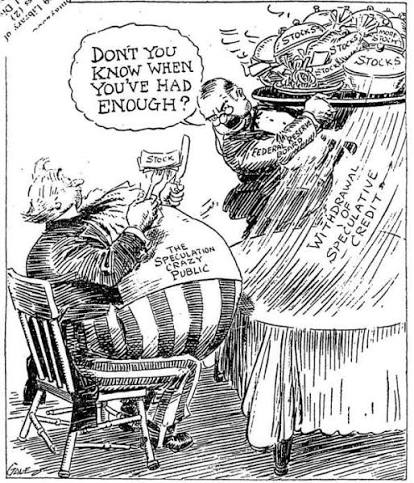
The United States’ Great Depression (1929-1933) represented the worst contraction of the U.S. economy in the country’s history, past and present. A historiographical question that has produced many scholarly books and articles, and as many theories, is: could the United States’ Great Depression have been avoided? Probably not, but it could have been reduced in severity. This blog will attempt to answer this question through the lens of Milton Friedman and Anna Schwartz’s Monetarist Theory, as argued in their monograph, A Monetary History of the United States, 1867–1960 (1963) Friedman and Schwartz’s Monetarist theory argued against the traditional economic theory of the system will fix itself and sought to overturn the prevailing Keynesian interpretation that saw monetary forces primarily as passive reflections of economic activity. The Great Depression became the most severe economic crisis in American history not primarily because of the stock market crash of 1929, but because the Federal Reserve allowed the nation’s money supply to collapse through a series of banking failures and policy mistakes. As Friedman and Schwartz argued, the Federal Reserve’s failure to provide liquidity and stabilize the banking system transformed an ordinary recession into a prolonged depression. Fifty years later, Michael D. Bordo and Hugh Rockoff, in Not Just the Great Contraction: Friedman and Schwartz’s A Monetary History of the United States, 1867 to 1960 (2013), argued that the book revolutionized both economic history and central banking by demonstrating the critical relationship between money supply, banking stability, and economic performance.2
This study uses qualitative historical analysis to connect Monetarist economic theory with primary and secondary evidence. The blog uses primary sources, such as the Federal Reserve Bulletins and Charles Hamlin’s diary and Herbert Hoover’s memoirs. The blog also uses a monograph by Milton Friedman and Anna Schwartz, A Monetary History of the United States, 1867–1960 (1963), as the primary synthesis of Monetarist theory. The temporal period that this blog’s analysis covers is 1927 to 1929, as those years contain the precursors to the collapse of the United States economic system.
Monetarist Theory
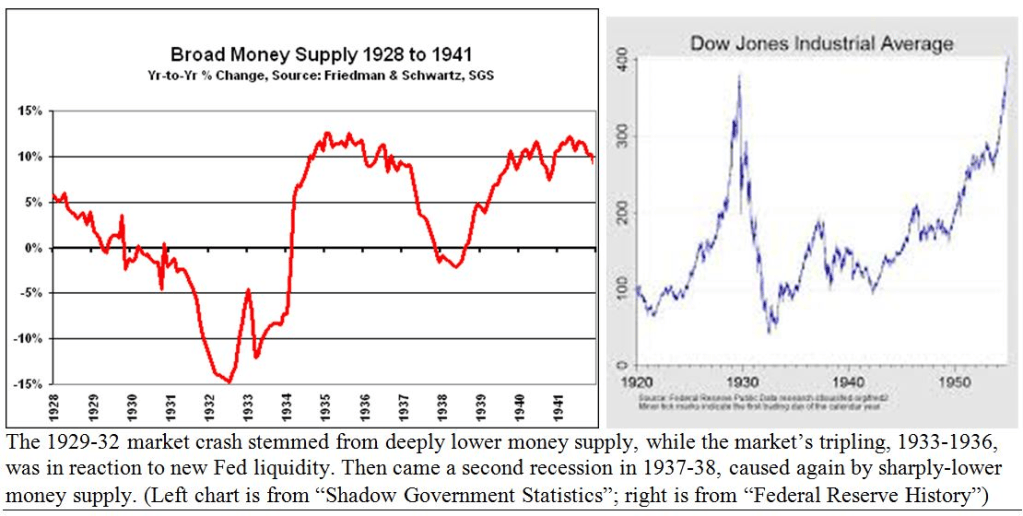
Milton Friedman and Anna Schwartz’s A Monetary History of the United States, 1867-1960 (1963) is the foundational text of the Monetarist interpretation of the Great Depression. Although the argument appears most directly in Chapter 7 (“The Great Contraction”), Friedman and Schwartz sought to overturn the prevailing Keynesian interpretation that saw monetary forces primarily as passive reflections of economic activity. Instead, they argued that changes in the money supply were frequently the driving force behind economic change. Their conclusion was that the Great Depression became “great” because the Federal Reserve allowed the money stock to collapse by roughly one-third between 1929 and 1933, despite possessing the power to prevent it.4 Perhaps the most important passage appears in their summary of the Great Depression: “By early 1933… the stock of money had fallen by one-third, the largest and longest decline in the entire period covered by our series.”5 This is the core empirical fact around which the monetarist interpretation revolves. The conclusion immediately follows: “The drastic decline in the stock of money … did not reflect the absence of power on the part of the Reserve System to prevent them.”6 This was arguably one of the most important statements in twentieth-century economic history. The Depression was not inevitable but resulted from policy failure.
Onward to Contraction
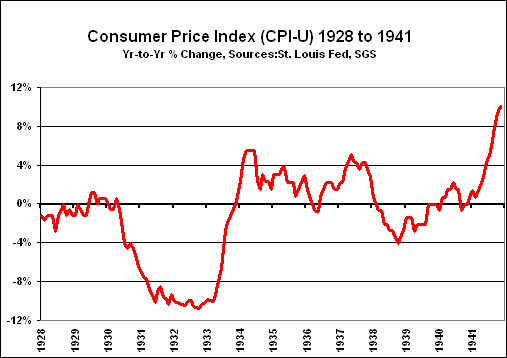
The years 1927 and 1928 provide ample evidence that the Federal Reserve Board realized that some action needed to be taken concerning the economy. They also showed that the Federal Reserve Board’s monetary policy was influenced by international concerns over domestic issues. In 1927, the United States economy remained relatively prosperous, yet policymakers were increasingly concerned with declining commodity prices, Britain’s gold reserve position, and stock-market speculation. During the 1927 Norman Strong Conference, which included banking representatives from the U.S., France, Britain, and Germany, European countries were not concerned with speculation in the U.S. but were interested in propping up the British Pound and protecting British gold reserves by lowering U.S. discount rates. Hamlin’s diary confirms this discussion as Federal Reserve Governor Benjamin Strong stated, “Great Britain cannot keep her gold unless (1) she raises her rate, or (2) we lower our rate.” Hamlin agreed, “he favored a 3-1/2% rate and a continuous buying of securities to make it effective.”8 Though Hamlin had concerns, “it might encourage stock speculation…”9 Yet the board concluded, “this should not be allowed to prevent doing what was best for business and agriculture.”10 Though Hamlin had concerns, “it might encourage stock speculation…”11 Herbert Hoover, as Secretary of Commerce in President Coolidge’s administration, confirmed the meeting between Strong and a European banker: “…spring of 1927 the same European bankers returned to the United States and with Governor Strong were most urgent that the policies of inflation of credit be resumed.”12 Hoover also took his concern over speculation to the New York bankers and promoters of the market; their answer was pithy: “…the New York Bankers all scoffed at the idea that the market was not ‘sound.’”13 This is one of the strongest primary-source statements available regarding the policy choice. Policymakers knowingly accepted speculative risks because they believed easier money would aid farmers, exporters, and commerce. Friedman and Schwartz saw 1927 as a major turning point: easy-money policy encouraged speculative excess, and monetary instability preceded the crash.
In 1928 the question before the Federal Reserve Board was: should we stabilize the economy, or should policy target speculation? The Federal Reserve Board decided to implement a policy of monetary restriction to reduce speculation, and this decision was one of the precursors to deflation and the contraction of the national money supply, which, in Monetarist view, caused the Great Depression. In September 1928, the country’s economy was in the final stages of the economic boom. The 1928 Federal Reserve Bulletin stated that the board was increasingly concerned about excessive credit growth, stock market speculation, declining gold reserves, and heavy member-bank borrowing. The bulletin acknowledged, “the banks of the country approach the season of heaviest demand for bank credit and currency… with a greatly increased volume of loans and investments and a heavy indebtedness at the reserve banks.”14 This statement demonstrates that policymakers already viewed credit conditions as usually tight before the crash. The bulletin also states its concern over speculation increases, “Brokers’ loans for account of others were about $1,880,000,000 in August, the largest volume on record.”15
The Straw the Broke the Camel’s Back
The September 1929 Federal Reserve Bulletin noted that “…member bank credit during the month showed little change in the aggregate.”16 From a Monetarist perspective, this was precisely the problem, as it demonstrated that money growth was slowing at a moment when demand for liquidity was rising, meaning that banks were in need of money. Also in 1929, the Federal Reserve was fixated with the popular idea that the economy was a part of a “New Era”, one in which economic principles of the past did not apply. The 1929 Federal Reserve Bulletin highlights this by praising a rate increase: “The discount rate of the Federal Reserve Bank of New York was increased from 5 to 6 percent.”17 The policy was intended to curb speculation, but instead the Federal Reserve eliminated itself from the speculative economic cycle. Corporations replaced the Federal Reserve as the intermediary between commercial banks and speculators. The corporations sold bonds, real estate mortgages, and securities to banks looking to cash in on the speculation; The corporations and banks bypassed the Federal Reserve because it was no longer profitable to go through the discount window. Friedman and Schwartz argued that the Federal Reserve’s 1929 increase in the New York discount rate reflected an excessive concern with stock-market speculation. By tightening credit and then failing to replace declining Federal Reserve credit through aggressive open-market operations, policymakers contributed to a contraction of the money supply that helped transform a recession into the Great Depression.18
Conclusion
According to Monetarists, the Federal Reserve had opportunities to make correct decisions that possibly would have reduced the depression to a recession and shortened its length. The Reserve’s decision to lower discount rates to appease European bankers in 1927, to focus on restricting speculation instead of taking an overall economic fix to the economy, and their restrictive monetary policies in 1929 to increase the discount rate shifted the burden of lending over to corporations, who leveraged bonds, real estate, and securities that they sold to banks. Due to the banks holding large amounts of non-agricultural notes, which the Federal Reserve legally could not loan money due to the outdated “Real Bills Doctrine,” which limited Reserve lending to short-term agriculture loans, there was nowhere for the banks to get liquidity when the Bank Panics took place, and there were runs on the banks. For that reason, Friedman and Schwartz state, “More than one-fifth of the commercial banks in the United States holding nearly one-tenth of the volume of deposits at the beginning of the contraction suspended operations because of financial difficulties.”19 In conclusion, Friedman and Schwartz argue, “The failure of the Federal Reserve System to prevent the collapse reflected not the impotence of monetary policy but rather the particular policies followed by the monetary authorities.”20 This statement directly attributes responsibility to Federal Reserve policymakers rather than to unavoidable economic forces. It serves as the core of the monetarist critique of Federal Reserve actions between 1929 and 1933.
As a note, the historiography of the economic contraction of the Great Depression is broad and varied. The Monetarist theory is but one of many theories that have been identified as probable causes of the economic collapse. Modern scholars tend to identify multiple structural and institutional failures as contributing to the Great Depression, shying away from a “silver bullet” answer to such a complex historical and economic event.
- National Humanities Center, Stock Market Crash of 1929: Political Cartoons, America in Class: Becoming Modern, America in the 1920s (2012), https://americainclass.org/sources/becomingmodern/prosperity/text4/politicalcartoonscrash.pdf. ↩︎
- Michael D. Bordo and Hugh Rockoff, “Not Just the Great Contraction: Friedman and Schwartz’s A Monetary History of the United States, 1867 to 1960,” NBER Working Paper No. 18828 (Cambridge, MA: National Bureau of Economic Research, February 2013), pp. 2-4. https://www.nber.org/system/files/working_papers/w18828/w18828.pdf. ↩︎
- Louis Navellier, “How the Fed’s Missteps Sparked the Great Depression in 1929,” Investing.com, November 1, 2025, https://www.investing.com/analysis/black-tuesday-turns-96-how-the-feds-missteps-sparked-the-great-depression-200669473 ↩︎
- Milton Friedman and Anna Jacobson Schwartz, A Monetary History of the United States, 1867-1960 (Princeton, NJ: Princeton University Press, 1963), 11. http://www.jstor.org/stable/j.ctt7s1vp. ↩︎
- Friedman and Schwartz, Monetary History, 10. ↩︎
- Friedman and Schwartz, Monetary History, 11. ↩︎
- John Williams, “Benchmark Revision to Nonfarm Payrolls & Great Depression Indicators,” Shadow Government Statistics, February 16, 2009, https://www.shadowstats.com/article/nonfarm-payrolls-great-depression-indicators. ↩︎
- Charles S. Hamlin and Merritt Sherman, Writings: “Memoranda Concerning the Federal Reserve Board…” Diary Vol. 14, 6 July 1927-18 July 1928. 837, Box 357, Folder 14, Charles S. Hamlin Papers, Federal Reserve Archival System for Economic Research (FRASER), accessed July 30, 2026, https://fraser.stlouisfed.org/archival/437/item/500125. ↩︎
- Hamlin and Sherman, “Memoranda Concerning the Federal Reserve Board,” 839. ↩︎
- Hamlin and Sherman, “Memoranda Concerning the Federal Reserve Board,” 840. ↩︎
- Hamlin and Sherman, “Memoranda Concerning the Federal Reserve Board,” 840 ↩︎
- Herbert Hoover, The Great Depression, 1929–1941, vol. 3 of The Memoirs of Herbert Hoover (New York: Macmillan Company, 1952), 10. ↩︎
- Hoover, The Great Depression, 17. ↩︎
- Board of Governors of the Federal Reserve System, “September 1928,” Federal Reserve Bulletin (September 1928), 642, Federal Reserve Archival System for Economic Research (FRASER), accessed July 28, 2026, https://fraser.stlouisfed.org/title/federal-reserve-bulletin-62/september-1928-20693. ↩︎
- Board of Governors of the Federal Reserve System, “September 1928,” 617. ↩︎
- Board of Governors of the Federal Reserve System, “September 1929,” Federal Reserve Bulletin (September 1929), 593, Federal Reserve Archival System for Economic Research (FRASER), Federal Reserve Bank of St. Louis, accessed July 28, 2026, https://fraser.stlouisfed.org/title/federal-reserve-bulletin-62/september-1929-20693. ↩︎
- Board of Governors of the Federal Reserve System, “September 1929,” 595. ↩︎
- Milton Friedman and Anna Jacobson Schwartz, A Monetary History of the United States, 1867-1960, chap. 7, “The Great Contraction, 1929-33” (Princeton, NJ: Princeton University Press, 1963), 340-44. ↩︎
- Friedman and Schwartz, A Monetary History of the United States, 1867-1960, 299. ↩︎
- Friedman and Schwartz, A Monetary History of the United States, 1867-1960, 300. ↩︎
 War Lens
Leave a comment