
How did the actions of Charles G. Dawes continue to enlarge the federal government’s administrative footprint, the origin of which began during the United States Civil War and Postbellum periods? The answer lies within the blog’s main argument: Charles G. Dawes’s service as Comptroller of the Currency and later as the first Director of the Bureau of the Budget reveals how the fiscal and banking structures originally developed to sustain wartime mobilization evolved into a permanent administrative mechanism, reinforcing the growth of federal authority in order to control the massive revenue and debt, that originated due to institutions created during the Civil War.
This study employs a historical institutionalist methodology to examine the long-term development of federal fiscal and administrative capacity in the United States from the Civil War through the early twentieth century. The exploration utilizes a combination of qualitative and quantitative analysis. Qualitative evidence is drawn from primary sources including the Treasury Reports of 1860-1865, Charles G. Dawes’s The Banking System of the United States (1894), the Annual Report of the Comptroller of the Currency (1901), Dawes’s official correspondence, and the Annual Report of the Director of the Bureau of the Budget (1922-1923). The interpretive framework is informed by Richard Franklin Bensel’s Yankee Leviathan (1990), Stephen Skowronek’s monograph, Building a New American State (1982), and Edward Goedeken’s article, Charles G. Dawes Establishes the Bureau of the Budget, 1921–1922 (1987). Together, these scholars suggest that federal authority did not simply expand during crises; rather, wartime financial and administrative innovations became enduring institutional foundations of the modern American state, with Dawes serving as an important link between the Civil War banking order and the twentieth-century administrative state.
Civil War Economy: 

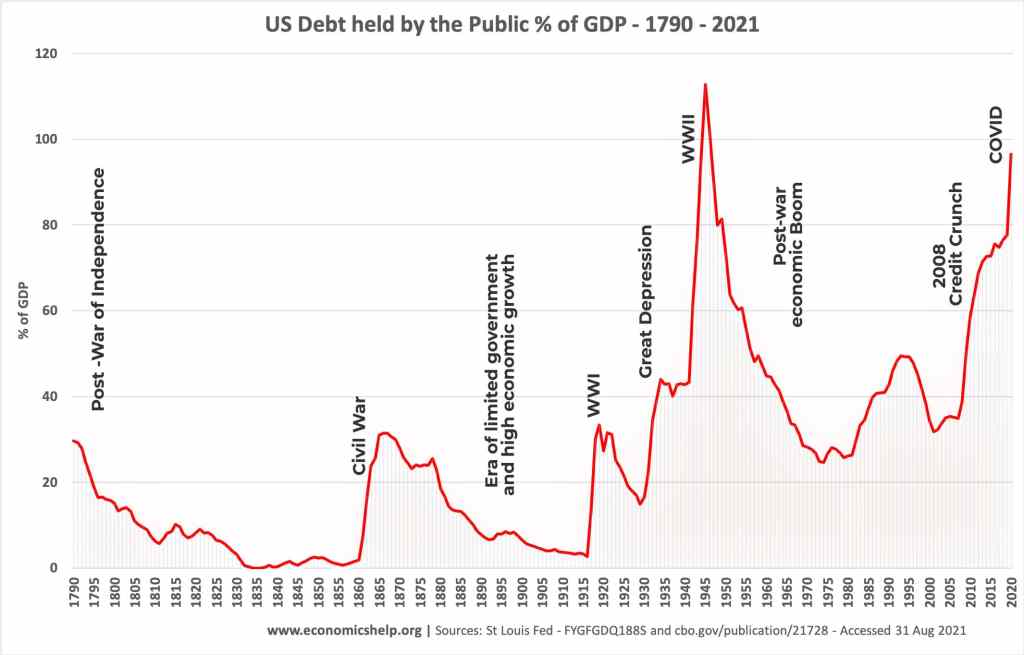
The above graph shows that the U.S. never returned to the low percentage of debt to GDP it had reached prior to the Civil War; in fact, the baseline continued to increase to the modern day.
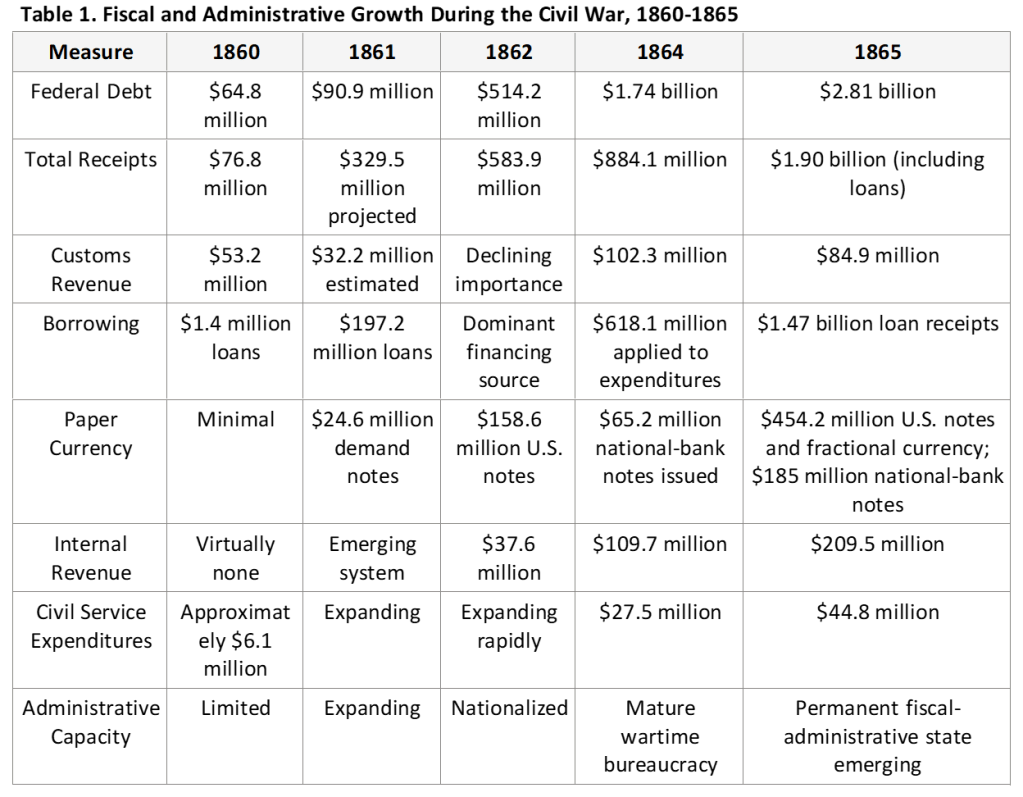
The charts below demonstrate the trajectory of revenue, expenditures, debt, and the size of the administrative state during the Civil War. By the end of the Civil War, a permanent administrative state was necessary to manage the increased centralization of power in the Federal Government. This increase originated through the 37th Congress and the Lincoln Administration, which passed laws that created the institutions in Table 2 below. The exponential administrative growth was necessary because the larger the debt, the larger the Treasury, the larger the accounting system, the greater the need for supervision, and the greater the need for national banking; the same is true for every institution created during the Civil War.
| Area | Key Act | Institution Created |
| Taxation | Internal Revenue Act (1862) | Internal Revenue Bureau |
| Currency | Legal Tender Act (1862) | Greenbacks |
| Banking | National Currency Act (1863) | Comptroller of the Currency |
| Banking | National Banking Act (1864) | National Banking System |
| Agriculture | Department of Agriculture Act (1862) | USDA |
| Education | Morrill Act (1862) | Land-Grant Colleges |
| Settlement | Homestead Act (1862) | Federal Land Administration |
| Transportation | Pacific Railroad Act (1862) | Federally Subsidized Railroad Network |
Civil Service Acts

There were two civil service acts passed by Congress that established and made permanent the administrative state. The first was the Pendleton Civil Service Reform Act of 1883, and the second was the Lloyd–La Follette Act of 1912. The Pendleton Act did not create new agencies or mandate additional positions. Instead, it established a merit-based system for filling certain federal jobs and created the Civil Service Commission. As the federal government expanded over subsequent decades, more positions were placed under civil-service protection rather than political patronage. The Lloyd-La Follette Act of 1912 did not authorize new positions or agencies. However, it made federal employment significantly more secure and professional. As a result, agencies could build long-term administrative staffs. That administrative permanence was essential to the growth of federal authority that Dawes later managed and expanded.
Charles G. Dawes 
The historiography of American state formation and fiscal development places Charles G. Dawes at the intersection of two major waves of national institution building. Dawes’s own writings, particularly The Banking System of the United States (1894), reveal a practitioner deeply concerned with the relationship between banking, credit, and national economic management, reflecting the maturation of the Civil War-era National Banking System into a permanent instrument of federal oversight. His later correspondence and public records further illuminate his belief in administrative efficiency and coordinated financial governance.
Charles G. Dawes was born in Marietta, OH, in 1865; he was the son of Union General Rufus R. Dawes. He built his career as a lawyer, banker, and Republican political operative before entering federal service. President William McKinley appointed Dawes Comptroller of the Currency in 1898, placing him in charge of supervising the national banking system created during the Civil War.
Comptroller of the Currency (1898-1901)
Table 3 below provides a comparative analysis of monetary institutions between 1861 and during Dawes’s tenure as Comptroller of the Currency in 1901. Dawes did not create the administrative state, but was a key figure in its developmental growth. According to Dawes, his philosophy on the Comptroller’s department was, “We shall not treat it as a private corporation organized for profit, but will regard it as in the nature of a public corporation.”3
Table 4 below demonstrates the changes that took place during Dawes’s tenure as Comptroller of the Currency. All of the changes indicate a growth in federal power during the time that Dawes was the Comptroller of the Currency. The table also demonstrates the lasting legacy of the Legal Currency Act of 1862, National Currency Act of 1863, and the National Banking Act of 1864. In 1861, the U.S. did not have one single national bank; by 1901, under Dawes’s administration, there were 4,221 national banks. Thus, weakening federalism for a strong central authority.
| Category | 1861 | 1901 (Dawes as Comptroller) | Significance |
| National Banks | None. The National Banking System had not yet been created.4 | 4,221 national banks operating under federal charters and federal supervision.5 | Demonstrates the emergence of a nationwide federally regulated banking system. |
| Federal Banking Regulator | No Comptroller of the Currency existed. Banking regulation remained primarily a state responsibility.6 | Comptroller of the Currency supervised all national banks and enforced federal banking regulations.7 | Shows the creation of a permanent administrative office and expansion of federal authority. |
| Banking Resources | Approximately $1.6 billion in total bank resources held largely by state-chartered institutions.8 | More than $5.69 billion in resources held by national banks alone.9 | Indicates the dramatic growth of federally supervised financial institutions. |
| Deposits | Approximately $250-$275 million in bank deposits.10 | $2.94 billion in deposits within the national banking system.11 | Demonstrates the public’s increasing reliance on federally regulated banks. |
| Currency Circulation | State bank notes circulated under varying standards and values. No uniform national currency existed.12 | More than $323 million in national bank notes circulated under federal authority.13 | Illustrates the success of Civil War currency reforms and the permanence of national monetary institutions. |
| Relationship to Federal Government | Financial institutions operated largely independent of direct federal oversight.14 | National banks were legally tied to federal debt, Treasury policy, and Comptroller supervision.15 | Shows how wartime fiscal institutions became permanent tools of governance. |
| Accomplishment | Evidence | Significance |
| Expansion of National Banking System16 | Reporting banks increased from 3,942 to 4,221; active national banks reached 4,279. | Demonstrates continued growth of the Civil War-created National Banking System. |
| Growth of National Bank Resources17 | Resources reached $5,695,347,294.96, the highest level in the history of the system to date. | Indicates enormous expansion of federally supervised finance. |
| Expansion of Loans and Credit18 | Loans and discounts rose to $3,018,615,918.40. | Demonstrates increasing availability of credit to support economic growth. |
| Growth of Bank Capital19 | Paid-in capital increased to $655,341,880. | Reflects greater financial stability and institutional strength. |
| Expansion of Deposits20 | Individual deposits reached $2,937,753,233.33. | Demonstrates growing public reliance on federally supervised banks. |
| Expansion of National Bank Currency21 | Outstanding circulation increased from $254,026,230 to $359,832,715, an increase of over 41 percent. | Expanded the national money supply and strengthened the national currency system. |
| Organization of New National Banks22 | 742 national banks organized between March 14, 1900, and October 31, 1901. | Extended banking services into smaller communities and broadened federal oversight. |
| Administrative Reform and Efficiency23 | Dawes was credited by his successor with maintaining a highly efficient and well-organized Comptroller’s Office. | Demonstrates his contribution to federal administrative capacity and professionalization. |
Director of the Bureau of Budgets (1921-1924)
After Dawes left the Comptroller’s office, he went back into banking until World War I. Dawes was commissioned as a major in the 17th Railway Engineers. He eventually became the chief of supply procurement for American troops in Europe and later served as the U.S. member of the Military Board of Allied Supply after Allied command was unified. Dawes’s military experience and network of people would heavily influence his next job as the first Director of the Bureau of Budgets. When the Bureau of the Budget was created the next year in 1921, President Warren Harding named Dawes as its first director. According to Goedeken, “Congress passed in 1921 the Budget and Accounting Act, which created the Bureau of the Budget.”24 The Act also created the General Accounting Office (GAO) and moved the duty of creating the budget to the President. Skowronek comments, “The budget would provide the chief executive with administrative responsibilities commensurate with his constitutional status as a governmental authority coequal with Congress and the judiciary.”25
Table 5 below illustrates the accomplishments that Dawes completed as Director of the Bureau of Budgets. The most important of those is that Dawes expanded federal administrative capacity. It is important to understand that Dawes did not accomplish this on his own; the legislative and presidential tiers of government passed the Budget and Accounting Act because World War I spending had ballooned, as noted in Table 1. The Act was passed to resume some control over the out-of-control spending that had taken place during and immediately after the war.
| Accomplishment | Evidence | Historical Significance |
| Organized the newly created Bureau of the Budget | Dawes became the first Director after passage of the Budget and Accounting Act of 1921.26 | Established the institutional foundation of modern executive budgeting. |
| Centralized federal budget preparation | The new system required a unified executive budget rather than separate departmental requests.27 | Strengthened presidential control over federal administration. |
| Introduced efficiency and business-management principles | Dawes promoted efficiency, economy, and administrative coordination throughout the executive branch.28 | Applied private-sector management practices to federal government operations. |
| Coordinated federal agencies | Dawes created interagency mechanisms to reduce duplication and improve oversight.29 | Expanded federal administrative capacity. |
| Imported World War I management techniques into peacetime government | Dawes recruited veterans of wartime procurement and administration.30 | Linked wartime administration to permanent governance structures. |
| Strengthened executive oversight of spending | Budget preparation became an executive responsibility rather than a fragmented congressional process.31 | Increased presidential influence over fiscal policy. |
| Created durable administrative reforms | Many of Dawes’s coordinating institutions remained in operation into the Franklin Roosevelt years.32 | Demonstrated the permanence of reforms initially justified by efficiency concerns. |
Conclusion
According to Richard Bensel, “The American state emerged from the wreckage of the Civil War.”33 The analysis in this blog supports that statement and builds on it using primary and secondary sources to demonstrate that though Charles G. Dawes did not create the administrative state, he participated in and supported the control the administrative state provided the federal government as it allowed the government to manage the immense amount of growth that took place during the Civil War, where wartime legislation transformed into permanent government institutions. The Civil War’s permanent institutions expanded during the postbellum and Progressive eras, resulting in a proto-modern administrative state. An analogy to this period would be that someone wins the lottery (16th Amendment), enjoys debt spending, so he/she hires a money manager and accountant, not to reduce debt, but to manage his 30-year annuity. Those managers hire accountants, rent space, and continue to grow, so in the end he/she needs to take out loans not only to continue his debt spending but to pay their fees also.

Footnotes:
- Tejvan Pettinger, “History of US National Debt,” Economics Help, October 1, 2025, https://www.economicshelp.org/blog/3018/economics/history-of-us-national-debt-gdp/. ↩︎
- United States Department of the Treasury, Report on the State of the Finances, 1860-1865; Richard Franklin Bensel, Yankee Leviathan: The Origins of Central State Authority in America, 1859-1877 (Cambridge: Cambridge University Press, 1990), 1-28. ↩︎
- Charles G. Dawes, The Banking System of the United States and Its Relation to the Money and Business of the Country (Chicago: Rand, McNally & Company, 1894), 7. ↩︎
- U.S. Department of the Treasury, Annual Report of the Secretary of the Treasury on the State of the Finances for the Year 1861 (Washington, DC: Government Printing Office, 1861), 14-20. ↩︎
- U.S. Comptroller of the Currency, Annual Report of the Comptroller of the Currency, 1901 (Washington, DC: Government Printing Office, 1901), xxxv-xxxvii. ↩︎
- U.S. Department of the Treasury, Annual Report of the Secretary of the Treasury on the State of the Finances for the Year 1861 (Washington, DC: Government Printing Office, 1861), 14-20. ↩︎
- U.S. Comptroller of the Currency, Annual Report of the Comptroller of the Currency, 1901 (Washington, DC: Government Printing Office, 1901), xxxv-xxxvii. ↩︎
- U.S. Department of the Treasury, Annual Report of the Secretary of the Treasury on the State of the Finances for the Year 1861, statistical appendices. ↩︎
- U.S. Comptroller of the Currency, Annual Report of the Comptroller of the Currency, 1901 (Washington, DC: Government Printing Office, 1901), xxxv-xxxvii. ↩︎
- U.S. Department of the Treasury, Annual Report of the Secretary of the Treasury on the State of the Finances for the Year 1861, statistical appendices. ↩︎
- U.S. Comptroller of the Currency, Annual Report of the Comptroller of the Currency, 1901 (Washington, DC: Government Printing Office, 1901), xxxv-xxxvii. ↩︎
- U.S. Department of the Treasury, Annual Report of the Secretary of the Treasury on the State of the Finances for the Year 1861 (Washington, DC: Government Printing Office, 1861), 14-20. ↩︎
- U.S. Comptroller of the Currency, Annual Report of the Comptroller of the Currency, 1901 (Washington, DC: Government Printing Office, 1901), xxxv-xxxvii. ↩︎
- U.S. Department of the Treasury, Annual Report of the Secretary of the Treasury on the State of the Finances for the Year 1861 (Washington, DC: Government Printing Office, 1861), 14-20. ↩︎
- Richard Franklin Bensel, Yankee Leviathan: The Origins of Central State Authority in America, 1859-1877 (Cambridge: Cambridge University Press, 1990), 320, 363-64 ↩︎
- U.S. Comptroller of the Currency, Annual Report of the Comptroller of the Currency, 1901 (Washington, DC: Government Printing Office, 1901), 10-11. ↩︎
- Comptroller of the Currency, Annual Report, 1901, 11. ↩︎
- Comptroller of the Currency, Annual Report, 1901, 11 ↩︎
- Comptroller of the Currency, Annual Report, 1901, 10-11. ↩︎
- Comptroller of the Currency, Annual Report, 1901, 12. ↩︎
- Comptroller of the Currency, Annual Report, 1901, 44. ↩︎
- Comptroller of the Currency, Annual Report, 1901, 21-23. ↩︎
- Comptroller of the Currency, Annual Report, 1901, 45 ↩︎
- Edward Goedeken, “Charles G. Dawes Establishes the Bureau of the Budget, 1921-1922,” The Historian 50, no. 1 (1987): 40. ↩︎
- Stephen Skowronek, Building a New American State: The Expansion of National Administrative Capacities, 1877-1920 (Cambridge: Cambridge University Press, 1982), 187. ↩︎
- Edward Goedeken, “Charles G. Dawes Establishes the Bureau of the Budget, 1921-1922,” The Historian 50, no. 1 (1987): 40. ↩︎
- Stephen Skowronek, Building a New American State: The Expansion of National Administrative Capacities, 1877-1920 (Cambridge: Cambridge University Press, 1982), 187-88. ↩︎
- Goedeken, “Charles G. Dawes Establishes the Bureau of the Budget,” 40. ↩︎
- Goedeken, “Charles G. Dawes Establishes the Bureau of the Budget,” 51-53. ↩︎
- Goedeken, “Charles G. Dawes Establishes the Bureau of the Budget,” 44. ↩︎
- Goedeken, “Charles G. Dawes Establishes the Bureau of the Budget,” 42. ↩︎
- Goedeken, “Charles G. Dawes Establishes the Bureau of the Budget,” 53. ↩︎
- Richard Franklin Bensel, Yankee Leviathan: The Origins of Central State Authority in America, 1859-1877 (Cambridge: Cambridge University Press, 1990), ix. ↩︎


Leave a Reply