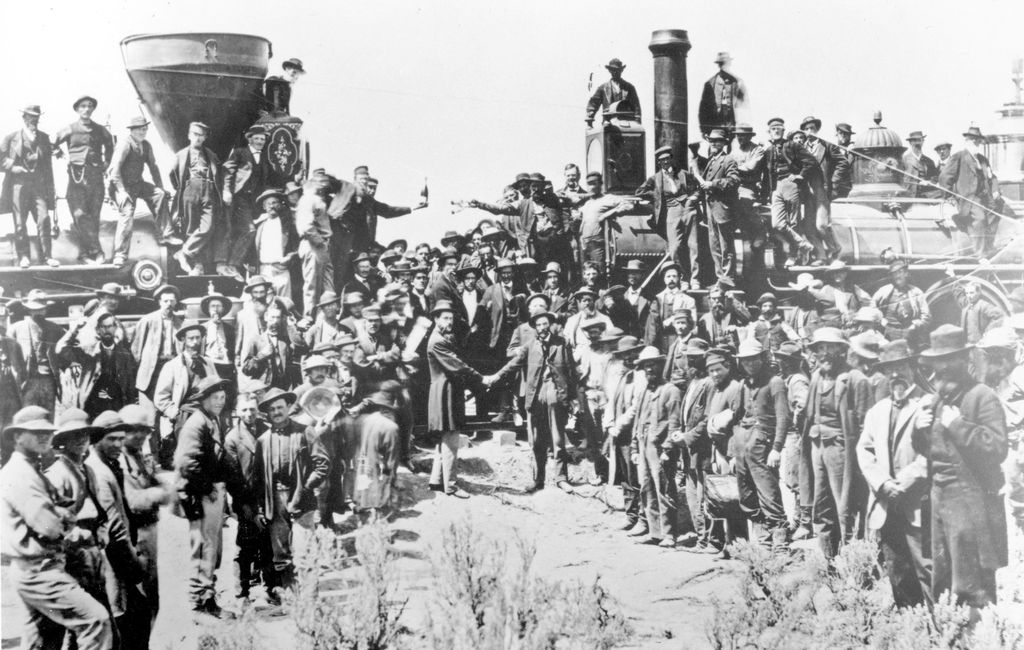
First transcontinental railroad met at Promontory Summit, Utah Territory, on May 10, 1869.
Introduction & Method
The postbellum period (1865-1890) of United States economic history laid the foundations for the institutions and infrastructure of future generations. The analysis will demonstrate that the railroad was not merely a transportation technology. It was the institutional infrastructure that connected wartime finance, western settlement, resource development, manufacturing growth, and managerial capitalism into a single national economic system. Manufacturing ultimately generated the largest share of industrial output, but railroads provided the transportation networks, market integration, financial mechanisms, and organizational structures that made large-scale industrialization possible.
To answer the historical question, a comparative historical analysis utilizing quantitative/statistical methodology and archival research utilizing digital tools to analyze primary source materials such as the 1860, 1870, and 1890 Census, the national debt found at the National Bureau of Economic Research, and gross domestic product (GDP) figures at the United States Department of the Treasury. The analysis includes a review of a prominent secondary source by Alfred D. Chandler Jr.
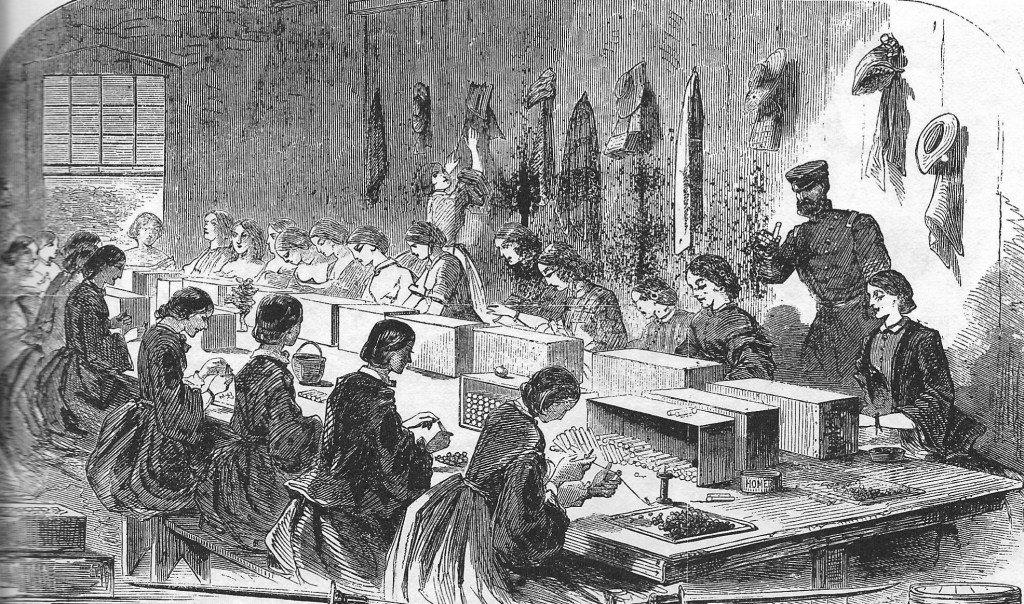
Women manufacturing ammunition during the Civil War
Civil War
During the United States Civil War (1861 – 1865), the United States national debt increased from $32 million dollars in 1856 to $2.7 billion dollars in 1865.[1] The majority of the debt resulted from the war, but the Lincoln administration and the 37th Congress also passed several non-war pieces of legislation, including the Pacific Railway Act of 1862, as amended in 1864, and the Homestead Act of 1862. These pieces of legislation facilitated the westward expansion of a population that grew from 32.2 million in 1861 to 63 million in 1890.[2] The Pacific Railway Act created the Union Pacific Railroad Company to create a transcontinental railroad. This act raised approximately $64 million through the sale of 30-year bonds at 6% interest, paid to the company in segments corresponding to 40 miles of completed track. The Act also provided for a land grant of 12,800 acres per mile of track; the land could be mortgaged or used at the company’s discretion.[3] The total land granted at completion equaled 174 million acres, at a cost of $300 to $500 million, and accounted for approximately 8% of the U.S. public domain. The 1862 Homestead Act provided 160 acres of land in the West and Great Plains regions of the U.S. to settlers for a filing fee of $10.[4] When it was finally phased out in Alaska in 1986, 270 million acres were transferred from federal hands into private ownership. These two acts provided the impetus for Westward expansion of population and railroads.
The GDP and GDP per capita increased every year during the Civil War from 4.59 and $145.06 in 1861 to 7.84 and $293.17 in 1865, and real GDP increased from $127,773,000 in 1865 to $395,405,000 in 1890.[5] The increase during the Civil War was due to the war and the westward expansion of people and railroads. In the postbellum period, the Second Industrial Revolution began in 1870, and synergy between manufacturing and Westward expansion fueled innovations in electricity, oil, cheap steel via the new Bessemer Process, protective tariffs, mass production, and the chemical industry, including fertilizers, explosives, and medicines.
Postbellum Period
The postbellum period saw the national debt reduced from 2.7 billion in 1865 to $1.5 billion in 1890 due to aggressive paydowns by the U.S. government.[6] The average GDP from 1866 to 1890 was 4.95, tapering off as we approached 1890 and the financial collapse during the Panic of 1893.[7] As we know, the population was increasing during the postbellum period due to immigration, which expanded the labor force available to support manufacturing growth. This population growth also led to the creation of many large cities. In 1800, the U.S. had 1 large city of 20-40 thousand people; by 1870, there were 39 cities of 40-75 thousand, up from 2 in 1800, and the first cities of 500,000 had appeared.[8]
How was all this growth possible? Was it due to the expansion and infrastructure of railroads or to the increase in the manufacturing base? Chandler states that it was due to the railroad’s creation of national markets for steel, agriculture, and timber. Chandler argues that by 1870, the 70,000 miles of track in operation provided the nation’s basic overland transportation network, and that manufacturing output increased from $1.9 billion in 1860 to $9.4 billion in 1890, with manufacturing expanding dramatically after railroad connectivity became national.[9] The U.S. manufacturing sector expanded from a regional base to a national base. He states, “The low speed of production and the slow movement of goods through the economy meant that the maximum daily activity at each point of production and distribution could be easily handled by small personally owned and managed enterprises.”[10] and also “In manufacturing, the railroad and the telegraph gave rise to mass production by encouraging the concentration within a single establishment of all or nearly all the processes involved in making a product.”[11] The analysis demonstrated that the expansion of the railroad led to increased manufacturing in the postbellum period.
In conclusion, as the government-subsidized railroad expanded Westward across the U.S., it shifted manufacturing from a regional to a national context. The expansion of the railroad led to increases in mining, oil and gas, steel, and timber production. As the population settled in the West through the railroad and government programs, manufacturing increased to support this movement. This analysis proves that the railroad drove economic growth in the postbellum period.
[8] United States Census Office, Ninth Census, 1870, and Francis Amasa Walker, Statistical Atlas of the United States Based on the Results of the Ninth Census, 1870, with Contributions from Many Eminent Men of Science and Several Departments of the Government (New York: J. Bien, 1874), https://www.loc.gov/item/05019329/.
[9] Alfred D. Chandler Jr., The Visible Hand: The Managerial Revolution in American Business (Cambridge, MA: Belknap Press of Harvard University Press, 1977), 81, https://hdl.handle.net/2027/heb00628.0001.001.
[10] Alfred D. Chandler Jr., The Visible Hand: The Managerial Revolution in American Business (Cambridge, MA: Belknap Press of Harvard University Press, 1977), 13, https://hdl.handle.net/2027/heb00628.0001.001.
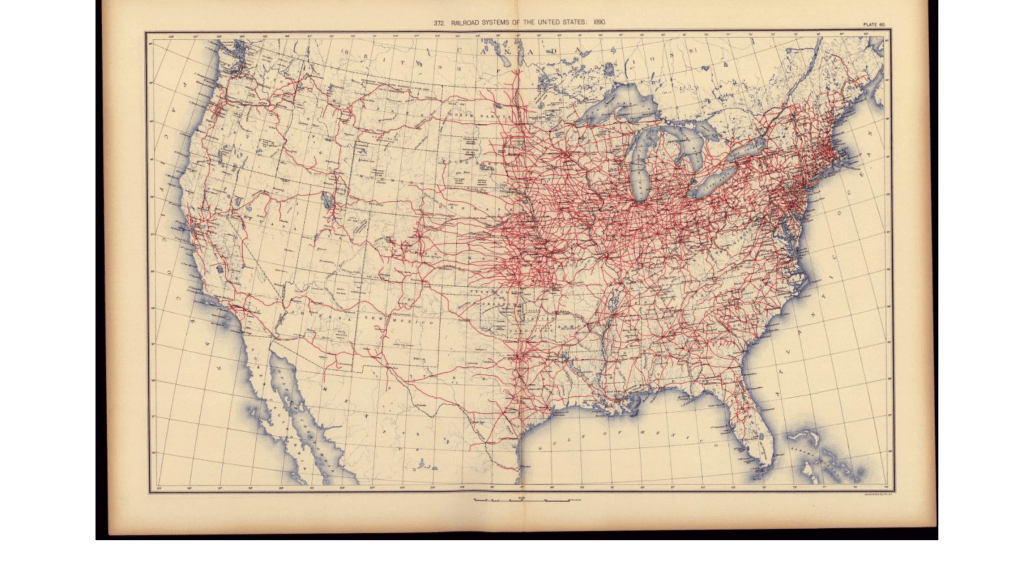
[12] Henry Gannett, Railroad System of the United States: 1890 (Washington, DC: Government Printing Office, 1898), Library of Congress, accessed July 8, 2026, https://www.loc.gov/resource/g3701gm.gct00010/.


Leave a Reply