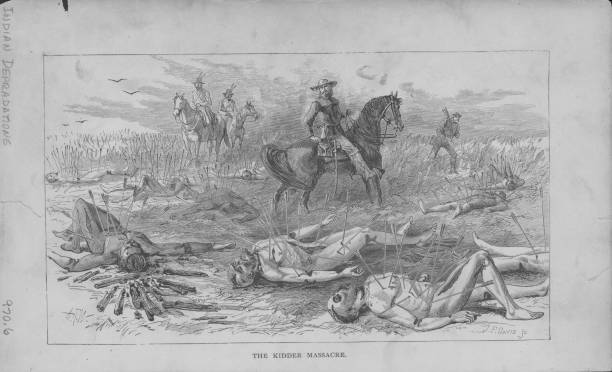
“One does not sell the earth upon which the people walk.” 1 (Crazy Horse)
The Battle of Slim Buttes, on September 9 and 10, 1876, in Dakota Territory, was fought within the larger context of the Great Sioux War or Sitting Bull’s War (1876-1877). Sitting Bull’s War origins began in 1874 when the U.S. Government broke the Treaty of 1868 (Fort Laramie Treaty) with their failure to enforce the treaty’s protection of the Black Hills from non-First Nations gold seekers. The Black Hills, known to the Lakota as Pahá Sápa, were the sacred homeland at the center of their spiritual and cultural world and was legally transferred to the Lakota nations in the Treaty of 1868. Sitting Bull’s War 1876-1877
Aftermath: Battle of the Little Bighorn
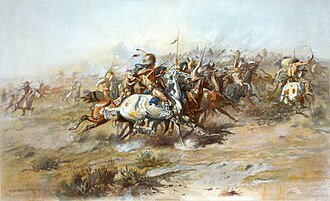
On June 25-26 of 1876, General George Custer’s 5 companies (C, E, F, I, L – 210 men) of the 7th Cavalry Regiment were killed to a man at the Battle of the Little Bighorn. This brutal defeat shocked the nation, emboldening Lakota resistance led by Sitting Bull and Crazy Horse. The loss also raised serious doubts about whether the Army could prevail on the northern plains. Little Bighorn Battlefield
After the battle, the Lakota and Cheyenne forces strategically dispersed into small, mobile groups, with different leaders pursuing different strategies. This classic Plains strategy allowed the tribes to avoid large engagements, relying instead on mobility, dispersed villages, and secure food supplies. One of the long-term outcomes of the Plains strategy was that there would not be a repeat of the Battle of the Little Bighorn.
The U.S. Army reacted by rushing reinforcements to the field; in total, more than 40% of the Federal army was deployed against the Lakota.2 There were two detachments, one led by the commander of the Department of the Dakota, General Alfred Terry, who led the Yellowstone Expedition, which disbanded after the Battle of the Little Bighorn. The other was General George Crook, who was in command of the Department of the Platte and led the Big Horn Expedition, which included over 2,000 infantry and cavalry who hunted the fading native footsteps across the plains.
The “Horsemeat March”
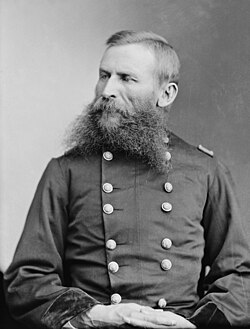
General George Crook’s Big Horn Expedition traveled from the Powder River Valley of what is now Wyoming to the Heart River in current North Dakota and started south towards the Black Hills of today’s South Dakota. Crook’s column was short on supplies, operating deep in contested territory, and living on reduced rations; this march was often called the “Horsemeat March” because it resorted to horse meat for sustenance. The New York Times reported Crook’s dispatch on September 20th, 1876: “We did not have a particle of wood, nothing but a little dry grass, which was insufficient even to cook coffee for the men.”3
The Battle of Slim Buttes
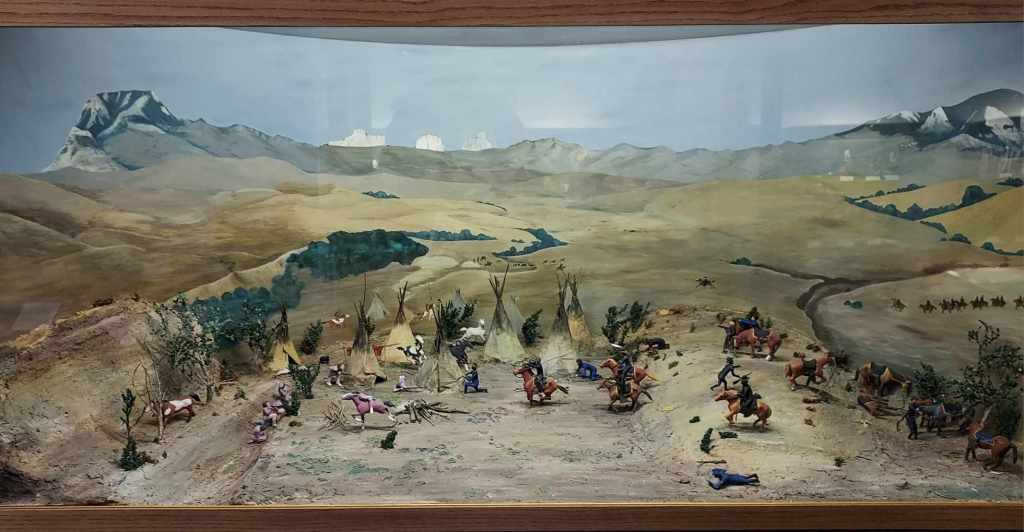
On September 9th, 1876, Captain Anson Mills, leading a detachment of the 150 troops of the 3rd U.S. Cavalry, sent ahead of Crook’s column to find food, discovered a Miniconjou Lakota village near Slim Buttes. This was not a major war camp; it was a subsistence village, led by Chief American Horse, containing families, horses, weapons, and winter provisions. Mills launched a surprise attack at dawn, capturing supplies and hundreds of ponies. According to The Baltimore Sun, published September 18, 1876, “There was an immense amount of dried meat, berries, etc., all that Crook’s pack train could carry.”4 They also found trophies from the Battle at the Little Bighorn massacre, “the guidon of the 7th Calvary…” and “…various little articles of wearing apparel…”5
Warriors that escaped Mill’s attack reached the encampment of Crazy Horse, some fifteen miles west of Slim Buttes, and informed him of the attack. Crazy Horse counterattacked, with 500 warriors, but Crook’s infantry and artillery arrived and held the field. The Sun reported on September 18, 1876, “It proved to be the result of reinforcements received from Crazy Horse’s Band, and a running attack was made all around the village…”6
Consequences
There were four consequences that resulted from Crook’s victory at the Battle of Slim Buttes;
1. Moral consequence: The battle restored the Federal army’s confidence that it could achieve victory.
2. Political consequence: the victory reassured political leaders in Washington and the public that continued military operations were viable, thus securing legal and financial support from Congress and the Ulysses S. Grant Administration.
3. Strategic consequence: most importantly, Slim Buttes demonstrated that destroying villages, food supplies, and horse herds was more decisive than seeking large battlefield engagements. The strategy of scorched earth had its roots in Secretary of the Army, Willian T. Sherman’s Civil War experiences. Sherman implemented this old strategy due to the Lakota’s use of asymmetrical warfare.
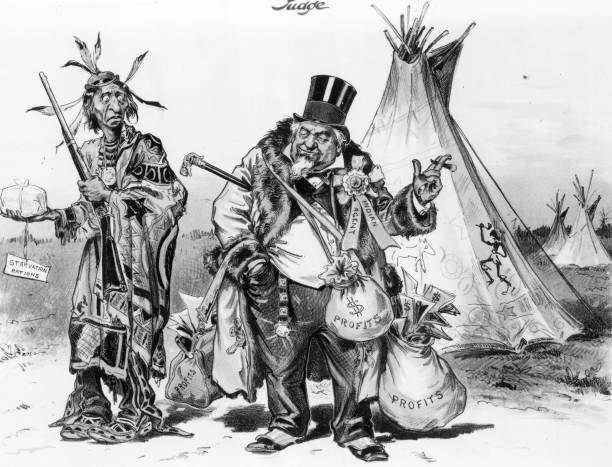
4. Cultural consequence: native tribes, who once were allowed to roam hunting grounds unhindered, were subjugated to life on reservations, relying on government-appointed Indian Agents to supply them with food, shelter, and protection.
The general attitude of U.S. citizens is summed up in the July 31st, 1876, St. Louis Globe, under the title, “Treating with Crazy Horse,” “Crazy Horse is so far from being a foreign potentate who has been waging lawful and civilized war against us, that he is merely a cruel and brutal cut-throat, dependent on our bounty. The guilt of his murders, robberies, and outrages is not at all obscured by the fact that there are several thousand cut-throats like him; on the contrary, this only intensifies the heinousness of his offense, and our first duty to Crazy Horse and society is to hang him as soon as we get him within our power.”7 Crazy Horse would be arrested at Fort Robinson in May of 1877, in current Nebraska, where he was allegedly killed while trying to escape.
The Battle of Slim Buttes and Crazy Horse: A South Dakota Heritage
It has been 150 years since the Battle of Slim Butte took place in what is currently Western South Dakota. If you wander to the site, on a lonely oil road, you will come upon a modest memorial, quietly honoring two fallen soldiers, a lone civilian, and even the severed limb left behind in the fury of battle. There is no memorial for the First Nation people who died during the battle, which is a testament to the continued healing of cultural relations in South Dakota. The area today is beautiful for its starkness, rolling landscape, and jutting buttes. It looked very similar 150 years ago, when a small but not inconsequential battle took place during what is referred to as Sitting Bull’s War, 1876-1877.
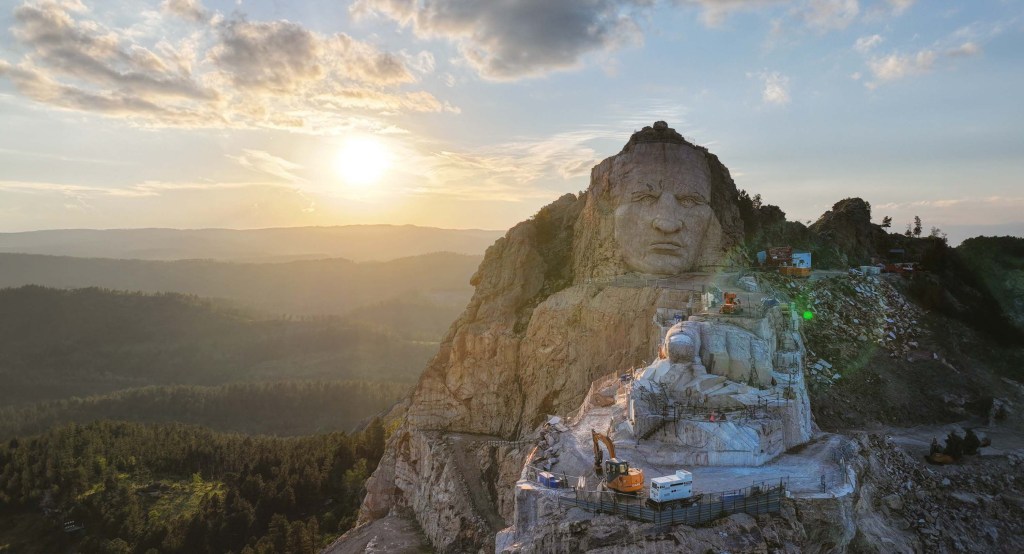
The memory of Crazy Horse, the Lakota Sioux warrior who gave his life to protect the Black Hills, lives on at the Crazy Horse Memorial, the Indian Museum of North America, and Crazy Horse Memorial University in the Black Hills. The memorial to Crazy Horse is the world’s largest mountain carving; when complete, Crazy Horse, upon his pony, will be pointing east, foreshadowing what was to come. Crazy Horse Memorial
- Dee Brown, Bury My Heart at Wounded Knee: An Indian History of the American West (New York: Holt, Rinehart and Winston, 1970), 268. ↩︎
- Paul L. Hedren, ed., The Great Sioux War of 1876–77 (Helena: Montana Historical Society Press, 1991). 14. ↩︎
- George Crook, “The Indian War,” Newark Advocate, September 22, 1876, Nineteenth Century U.S. Newspapers (accessed May 4, 2026). ↩︎
- “Another Brush with Indians: Crook and Miles on the War Path—Sioux Village Raided—Capture of Ponies—The Killed and Wounded,” The Sun (New York), September 18, 1876, 1. ↩︎
- “Another Brush with Indians,” The Sun (New York), September 18, 1876, 1. ↩︎
- “Another Brush with Indians,” The Sun (New York), September 18, 1876, 1. ↩︎
- “Treating with Crazy Horse,” St. Louis Globe-Democrat, July 31, 1876, 4, Nineteenth Century U.S. Newspapers (accessed May 4, 2026). ↩︎


 War Lens
Leave a comment